Wednesday, January 27, 2010
Howard Zinn died 27 January 2009
Democracy Now! has a good little write up of Howard Zinn, who commented on the show frequently.

Howard Zinn died 27 January 2009
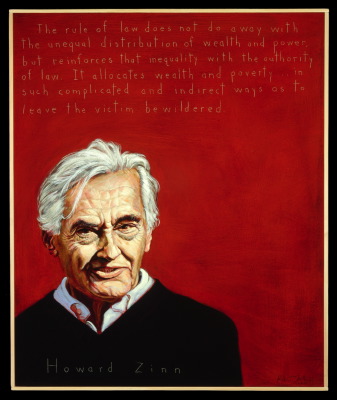
I would like to make a small post mention of US historian Howard Zinn, author (and activist) of A People's History of the United States. Which has been copied by nearly everyone, including Christianity. The book has its own wikipedia entry. Howard Zinn passed away yesterday which is a tragic loss to history and humanity. Zinn was an activist who spoke out against the unbelieveable corruption and war criminals who lead the US over the last decade, as well as being vocal against the elites who have dominated US history. His book will be recommended reading in my history class this year. You can find a number of his books, interviews and speeches/lectures online. I'll finish with some quotes of his:
If those in charge of our society — politicians, corporate executives, and owners of press and television — can dominate our ideas, they will be secure in their power. They will not need soldiers patrolling the streets. We will control ourselves
There is no flag large enough to cover the shame of killing innocent people for a purpose which is unattainable
It is possible, reading standard histories, to forget half the population of the country. The explorers were men, the landholders and merchants men, the political leaders men, the military figures men. The very invisibility of women, the overlooking of women, is a sign of their submerged status
And my favourite, (thanks to friend Rebekah Nathan for sharing):
I suggest that if you know history, then you might not be so easily
fooled by the government when it tells you you must go to war for this
or that reason -that history is a protective armor against being
misled
Tuesday, January 26, 2010
The Value of Nothing
Would like to read Raj Patal's new book, The Value of Nothing. Here is a preview:
I love that Oscar Wilde quote: 'people know the price of everything and the value of nothing'. Looks a little Naomi Kleinesque, which is all good. Perhaps i should read his first book first though...
I love that Oscar Wilde quote: 'people know the price of everything and the value of nothing'. Looks a little Naomi Kleinesque, which is all good. Perhaps i should read his first book first though...
Sunday, January 24, 2010
Religion and Facebook
Here is an interesting article from Christianity Today about 'Religious Self-Profiling' on new social media sites like MySpace and Facebook. It looks at how young people (majority users of SNS) define their religion (in the 100 words or less) in their status. It draws on this research from a University of North Carolina PhD student.
What they discover is that often people's religious views are implicit and ambigious, as opposed to outright 'evangelical', 'Christian'. They may uses other coded references such as their offline activity etc. They conclude that perhaps young people are more concerned to not limit their marketability to others and also because explicit Christian labels may have negative politic/social connotations they do not want to be associated with.
What they discover is that often people's religious views are implicit and ambigious, as opposed to outright 'evangelical', 'Christian'. They may uses other coded references such as their offline activity etc. They conclude that perhaps young people are more concerned to not limit their marketability to others and also because explicit Christian labels may have negative politic/social connotations they do not want to be associated with.
Paul Farmer on Haiti - A Must Read
Paul Farmer has an excellent article on Haiti's history and the brutal colonial involvement of the French and the US. Well worth the investment of time to read it. Paul Farmer is: physician and anthropologist, is Maud and Lillian Presley Professor at Harvard Medical School and author of 'The Uses of Haiti' and 'Pathologies of Power'. I have a copy of the second book but have not read it yet. Some extracts:
International financial institutions engaged in discriminatory and probably illegal practices towards Haiti. According to the London-based Haiti Support Group,
Haiti’s debt to international financial institutions and foreign governments has grown from $302 million in 1980 to $1.134 billion today. About 40 per cent of this debt stems from loans to the brutal Duvalier dictators, who invested precious little of it in the country. This is known as ‘odious debt’ because it was used to oppress the people, and, according to international law, this debt need not be repaid.
Yet in order to meet the renewed demands of the IDB, the cash-strapped Haitian government was required to pay ever-expanding arrears on its debts, many of them linked to loans paid out to the Duvalier dictatorship and to the military regimes that ruled Haiti with great brutality from 1986 to 1990. In July 2003, Haiti sent more than 90 per cent of all its foreign reserves to Washington to pay off these arrears. As of today, less than $4 million of the four blocked loans – which totalled $146 million – has reached Haiti in spite of many assurances from the IDB.
That the US and France undermined Aristide is not a fringe opinion. The Caribbean Community (CARICOM) and the African Union have called for a formal investigation into his removal. ‘Most people around the world believe that Aristide’s departure was at best facilitated, at worst coerced by the US and France,’ Gayle Smith, a member of the National Security Council staff under Clinton, recently said.
Why such animus towards Haiti’s leader? Taking up the question of the historic French debt, Aristide declared that France ‘extorted this money from Haiti by force and . . . should give it back to us so that we can build primary schools, primary healthcare, water systems and roads.’ He did the maths, adding in interest and adjusting for inflation, to calculate that France owes Haiti $21,685,135,571.48 and counting. This figure was scoffed at by some of the French, who saw the whole affair as a farce mounted by their disgruntled former subjects; others, it’s increasingly clear, were insulted or angered when the point was pressed in diplomatic and legal circles.
And here is an extract from Naomi Klein's the Shock Doctrine: The Rise of Disaster Capitalism, on how disasters such as in Haiti pave the way for harmful political policies - often by external powers:
Despite all the successful attempts to exploit the 2004 tsunami, memory also proved to be an effective tool of resistance in some areas where it struck, particularly in Thailand. Dozens of coastal villages were flattened by the wave, but unlike in Sri Lanka, many Thai settlements were successfully rebuilt within months. The difference did not come from the government. Thailand's politicians were just as eager as those elsewhere to use the storm as an excuse to evict fishing people and hand over land tenure to large resorts. Yet what set Thailand apart was that villagers approached all government promises with intense skepticism and refused to wait patiently in camps for an official reconstruction plan. Instead, within weeks, hundreds of villagers engaged in what they called land "reinvasions."
They marched past the armed guards on the payroll of developers, tools in hand, and began marking off the sites where their old houses had been. In some cases, reconstruction began immediately. "I am willing to bet my life on this land, because it is ours," said Ratree Kongwatmai, who lost most of her family in the tsunami.
The most daring reinvasions were performed by Thailand's indigenous fishing peoples called the Moken, or "sea gypsies." After centuries of disenfranchisement, the Moken had no illusions that a benevolent state would give them a decent piece of land in exchange for the coastal properties that had been seized. So, in one dramatic case, the residents of the Ban Tung Wah Village in the Phang Nga province "gathered themselves together and marched right back home, where they encircled their wrecked village with rope, in a symbolic gesture to mark their land ownership," explained a report by a Thai NGO. "With the entire community camping out there, it became difficult for the authorities to chase them away, especially given the intense media attention being focused on tsunami rehabilitation." In the end, the villagers negotiated a deal with the government to give up part of their oceanfront property in exchange for legal security on the rest of their ancestral land. Today, the rebuilt village is a showcase of Moken culture, complete with museum, community centre, school and market. "Now, officials from the sub-district come to Ban Tung Wah to learn about 'people-managed tsunami rehabilitation' while researchers and university students turn up there by the bus-full to study 'indigenous people's wisdom.'"
All along the Thai coast where the tsunami hit, this kind of direct-action reconstruction is the norm. The key to their success, community leaders say, is that "people negotiate for their land rights from a position of being in occupation"; some have dubbed the practice "negotiating with your hands." Thailand's survivors have also insisted on a different kind of aid-rather than settling for handouts, they have demanded the tools to carry out their own reconstruction. Dozens of Thai architecture students and professors, for example, volunteered to help community members design their new houses and draw their own rebuilding plans; master boat builders trained villagers to make their own, more sophisticated fishing vessels. The results are communities stronger than they were before the wave. The houses on stilts built by Thai villagers in Ban Tung Wah and Baan Nairai are beautiful and sturdy; they are also cheaper, larger and cooler than the sweltering prefab cubicles on offer there from foreign contractors. A manifesto drafted by a coalition of Thai tsunami survivor communities explains the philosophy: "The rebuilding work should be done by local communities themselves, as much as possible. Keep contractors out, let communities take responsibility for their own housing."
Uniting all these examples of people rebuilding for themselves is a common theme: participants say they are not just repairing buildings but healing themselves. It makes perfect sense. The universal experience of living through a great shock is the feeling of being completely powerless: in the face of awesome forces, parents lose the ability to save their children, spouses are separated, homes-places of protection-become death traps. The best way to recover from helplessness turns out to be helping-having the right to be part of a communal recovery. "Reopening our school says this is a very special community, tied together by more than location but by spirituality, by bloodlines and by a desire to come home," said the assistant principal of Dr. Martin Luther King Jr. Elementary School in the Lower Ninth Ward of New Orleans.
International financial institutions engaged in discriminatory and probably illegal practices towards Haiti. According to the London-based Haiti Support Group,
Haiti’s debt to international financial institutions and foreign governments has grown from $302 million in 1980 to $1.134 billion today. About 40 per cent of this debt stems from loans to the brutal Duvalier dictators, who invested precious little of it in the country. This is known as ‘odious debt’ because it was used to oppress the people, and, according to international law, this debt need not be repaid.
Yet in order to meet the renewed demands of the IDB, the cash-strapped Haitian government was required to pay ever-expanding arrears on its debts, many of them linked to loans paid out to the Duvalier dictatorship and to the military regimes that ruled Haiti with great brutality from 1986 to 1990. In July 2003, Haiti sent more than 90 per cent of all its foreign reserves to Washington to pay off these arrears. As of today, less than $4 million of the four blocked loans – which totalled $146 million – has reached Haiti in spite of many assurances from the IDB.
That the US and France undermined Aristide is not a fringe opinion. The Caribbean Community (CARICOM) and the African Union have called for a formal investigation into his removal. ‘Most people around the world believe that Aristide’s departure was at best facilitated, at worst coerced by the US and France,’ Gayle Smith, a member of the National Security Council staff under Clinton, recently said.
Why such animus towards Haiti’s leader? Taking up the question of the historic French debt, Aristide declared that France ‘extorted this money from Haiti by force and . . . should give it back to us so that we can build primary schools, primary healthcare, water systems and roads.’ He did the maths, adding in interest and adjusting for inflation, to calculate that France owes Haiti $21,685,135,571.48 and counting. This figure was scoffed at by some of the French, who saw the whole affair as a farce mounted by their disgruntled former subjects; others, it’s increasingly clear, were insulted or angered when the point was pressed in diplomatic and legal circles.
And here is an extract from Naomi Klein's the Shock Doctrine: The Rise of Disaster Capitalism, on how disasters such as in Haiti pave the way for harmful political policies - often by external powers:
Despite all the successful attempts to exploit the 2004 tsunami, memory also proved to be an effective tool of resistance in some areas where it struck, particularly in Thailand. Dozens of coastal villages were flattened by the wave, but unlike in Sri Lanka, many Thai settlements were successfully rebuilt within months. The difference did not come from the government. Thailand's politicians were just as eager as those elsewhere to use the storm as an excuse to evict fishing people and hand over land tenure to large resorts. Yet what set Thailand apart was that villagers approached all government promises with intense skepticism and refused to wait patiently in camps for an official reconstruction plan. Instead, within weeks, hundreds of villagers engaged in what they called land "reinvasions."
They marched past the armed guards on the payroll of developers, tools in hand, and began marking off the sites where their old houses had been. In some cases, reconstruction began immediately. "I am willing to bet my life on this land, because it is ours," said Ratree Kongwatmai, who lost most of her family in the tsunami.
The most daring reinvasions were performed by Thailand's indigenous fishing peoples called the Moken, or "sea gypsies." After centuries of disenfranchisement, the Moken had no illusions that a benevolent state would give them a decent piece of land in exchange for the coastal properties that had been seized. So, in one dramatic case, the residents of the Ban Tung Wah Village in the Phang Nga province "gathered themselves together and marched right back home, where they encircled their wrecked village with rope, in a symbolic gesture to mark their land ownership," explained a report by a Thai NGO. "With the entire community camping out there, it became difficult for the authorities to chase them away, especially given the intense media attention being focused on tsunami rehabilitation." In the end, the villagers negotiated a deal with the government to give up part of their oceanfront property in exchange for legal security on the rest of their ancestral land. Today, the rebuilt village is a showcase of Moken culture, complete with museum, community centre, school and market. "Now, officials from the sub-district come to Ban Tung Wah to learn about 'people-managed tsunami rehabilitation' while researchers and university students turn up there by the bus-full to study 'indigenous people's wisdom.'"
All along the Thai coast where the tsunami hit, this kind of direct-action reconstruction is the norm. The key to their success, community leaders say, is that "people negotiate for their land rights from a position of being in occupation"; some have dubbed the practice "negotiating with your hands." Thailand's survivors have also insisted on a different kind of aid-rather than settling for handouts, they have demanded the tools to carry out their own reconstruction. Dozens of Thai architecture students and professors, for example, volunteered to help community members design their new houses and draw their own rebuilding plans; master boat builders trained villagers to make their own, more sophisticated fishing vessels. The results are communities stronger than they were before the wave. The houses on stilts built by Thai villagers in Ban Tung Wah and Baan Nairai are beautiful and sturdy; they are also cheaper, larger and cooler than the sweltering prefab cubicles on offer there from foreign contractors. A manifesto drafted by a coalition of Thai tsunami survivor communities explains the philosophy: "The rebuilding work should be done by local communities themselves, as much as possible. Keep contractors out, let communities take responsibility for their own housing."
Uniting all these examples of people rebuilding for themselves is a common theme: participants say they are not just repairing buildings but healing themselves. It makes perfect sense. The universal experience of living through a great shock is the feeling of being completely powerless: in the face of awesome forces, parents lose the ability to save their children, spouses are separated, homes-places of protection-become death traps. The best way to recover from helplessness turns out to be helping-having the right to be part of a communal recovery. "Reopening our school says this is a very special community, tied together by more than location but by spirituality, by bloodlines and by a desire to come home," said the assistant principal of Dr. Martin Luther King Jr. Elementary School in the Lower Ninth Ward of New Orleans.
Thursday, January 21, 2010
Some News Links Round -Up
Thought I would quickly keep my postings regular by adding some stuff i've been reading today, briefly.
This is unbelievable, but a US arms manufacturer has been making weapons with special light/scopes on them for better vision when shooting people in Afghanistan. They also happened to put a bible verse on it. New Zealand troops have been using these weapons overseas. Here is the Guardian story. This is so shocking and incredibly offensive to Christian's who believe Jesus was a bringer of peace, not war and weapons to kill people with. As the Guardian reports, there were two verses printed on the weapons:
Markings included "JN8:12", a reference to John 8:12: "Then spake Jesus again unto them, saying, 'I am the light of the world: he that followeth me shall not walk in darkness, but shall have the light of life,'" according to the King James version of the Bible.
The Trijicon Reflex sight is stamped with 2COR4:6, a reference to part of the second letter of Paul to the Corinthians: "For God, who commanded the light to shine out of darkness, hath shined in our hearts, to give the light of the knowledge of the glory of God in the face of Jesus Christ," the King James version reads.
I'm pretty sure that is not what Jesus had in mind. The story was also picked up by Fox, the New Zealand Herald
Kofi Annan talks about 'Turning Haiti around' here.
A horrific article on lower caste people in India whose job it is to manually clean up people's urine and crap. My cousin works for WaterAid, an ngo which released this report. As she said on Facebook, if you think you have the worst job, read this.
And finally, a nostalgic review of the Kraft buying Cadbury deal, which I have to say I agree with. It is a sad thing for everything to be made by one giant company. As Naomi Klein wrote about in NoLogo. What is more concerning is whether this deal will end Cadbury's commitment to FairTrading it's Dairy Milk line. I think it does. But here's hoping.
And after all that, it looks like all i do is link to the Guardian. Maybe everyone should just read that.
This is unbelievable, but a US arms manufacturer has been making weapons with special light/scopes on them for better vision when shooting people in Afghanistan. They also happened to put a bible verse on it. New Zealand troops have been using these weapons overseas. Here is the Guardian story. This is so shocking and incredibly offensive to Christian's who believe Jesus was a bringer of peace, not war and weapons to kill people with. As the Guardian reports, there were two verses printed on the weapons:
Markings included "JN8:12", a reference to John 8:12: "Then spake Jesus again unto them, saying, 'I am the light of the world: he that followeth me shall not walk in darkness, but shall have the light of life,'" according to the King James version of the Bible.
The Trijicon Reflex sight is stamped with 2COR4:6, a reference to part of the second letter of Paul to the Corinthians: "For God, who commanded the light to shine out of darkness, hath shined in our hearts, to give the light of the knowledge of the glory of God in the face of Jesus Christ," the King James version reads.
I'm pretty sure that is not what Jesus had in mind. The story was also picked up by Fox, the New Zealand Herald
Kofi Annan talks about 'Turning Haiti around' here.
A horrific article on lower caste people in India whose job it is to manually clean up people's urine and crap. My cousin works for WaterAid, an ngo which released this report. As she said on Facebook, if you think you have the worst job, read this.
And finally, a nostalgic review of the Kraft buying Cadbury deal, which I have to say I agree with. It is a sad thing for everything to be made by one giant company. As Naomi Klein wrote about in NoLogo. What is more concerning is whether this deal will end Cadbury's commitment to FairTrading it's Dairy Milk line. I think it does. But here's hoping.
And after all that, it looks like all i do is link to the Guardian. Maybe everyone should just read that.
Tuesday, January 19, 2010
Haiti analysis and critique....
Found these two articles interesting.
One from NYtimes coloumist David Brooks on Haiti. And a response/translation of Brooks underlying assumptions here.
One from NYtimes coloumist David Brooks on Haiti. And a response/translation of Brooks underlying assumptions here.
Subscribe to:
Posts (Atom)

 Posts
Posts

