Tuesday, December 15, 2009

Expand or Restrain?

I usually enjoy British journalist George Monbiot. His recent article in the Guardian from the Copenhagen Climate Conference is definitely worth reading. He argues that political fault lines now lye beyond liberal/conservative and are better labelled, expanders and restrainers. He argues that now, more than ever, we need to exercise restraint in how we live. We cannot expand endlessly, we cannot continue to (ab)use our planet the way we are used to. He takes a swipe at those expander's (and their copies of Atlas Shrugged that they cling to) who believe there are no limits for their growth. We need to move from an 'Age of Heroism' towards an 'Age on Accommodation'.

The problem, which Monbiot does mention, is that at heart humanity is desperately trying to pursue its 'better angels', as Lincoln put it. This is difficult for us creatures, in the hyper-real, consumer capitalist, liberal society in which we live. I would not be the one to cast the first stone to the expander's. Even now I'm thinking of all the 'things' I want to own. But what does that all matter? Even if the world doesn't end in my lifetime? No, Monbiot is right, this issue is so much bigger than Climate Change, it is about defining ourselves as humans. I don't know how else to end this post, than with the words of 1970’s Anglican Kenyan-theologian, John Mbiti, who coined a famous statement of humanness. It is expressed in terms of sharing: “I am because we are, and since we are therefore I am”

Amen.

Sunday, December 6, 2009

Where the Wild Things Are


On the weekend I went and saw Where the Wild Things Are. It was a really good movie, a great story of the wild/raw emotions of childhood, the frustrations and easily triggered happiness, sadness, anger. I couldn't remember much from the book. Only that Max went an island to escape family and then kind of danced with the Wild Things and he was the king of them or something like that anyway. The film fills or expands on this plot substantially, with Dave Eggers helping to write the screenplay. It worked wonderfully, with a really captivating story which is actually rather scary. From the massive crashing waves Max has to negotiate to get to the island, to the unpredictable nature of the Wild Things, with one, Judith, being particularly edgy with Max. In truth, the film is remarkably sad. In my mind, the part which resonated most with myself and childhood, was the idealism/belief that things should be "ok, normal, fun and happy", for me that represented mom, dad, family all together. Change comes like a rushing wind on childhood, blowing down even the most well constructed fortress.

The film also resonated with a conversation I had with my brother. I showed him a kids toy which said something like, "for good child development" or something similar to the whole "baby Einstein" thing (which research has shown doesn't actually do anything). And my brother replied, all you need for child development is a good stick (or something to that effect). This film is one really good stick, putting wild rumpus physical adventure and childhood together. Where they should be.

Thursday, December 3, 2009

Ugandan Gay Witch Hunt

Andrew Brown from the Guardian has reported on a shocking and terrifiying bill before the Ugnadan government which would turn even discussing homosexuality into a crime. As he writes:

'A bill currently before the Ugandan parliament (pdf) proposes seven year prison sentences for discussing homosexuality; life imprisonment for homosexual acts; and death for a second offence. Sober observers believe it will be passed. The Anglican church in Uganda appears to support it, and the Church of England in this country is absolutely silent. The Archbishop of Canterbury and the Bishop of Winchester solemnly denounce violence in the Congo, where they have no influence at all, but on Uganda they maintain a resolute post-colonial silence.'

'This is a witch craze, pure and simple. It takes the perfectly genuine prejudices of the ignorant, inflames them, and enshrines them in law. I do not expect any bishop of the Church of England to have the courage to speak against it. Give them a hundred years, though, and they will turn up at a memorial service to weep for the victims.'


I just posted on Rowan Williams' speaking out against the violence in the Congo, but it is shocking to read this is going on. Perhaps the most important things Brown highlights is the connections between these more conservative (some, like this, extremists) Christians in some African countries and those in the US. I believe there is a type of romanticisim of Christianity in Africa, South America and China, where conservative American Christians, seeing their political influence wanning see support and encouragement and even justification for their positions towards homosexuality from these more conservative churches which are growing in the developing world. Indeed, the report by Political Research Associates, called Globalizing the Culture Wars, highlights this trend: 'U.S. social conservatives, who are in the minority in mainline churches, depend on African religious leaders to legitimize their positions as their growing numbers makes African Christians more influential globally.'

The Church should be at the forefront of speaking out against discrimination and violence against people because of their sexual orientation.

Self Defense and Non Violence

I've just finished reading Christopher B. Strain's Pure Fire: Self-Defense as Activism in the Civil Rights Era.
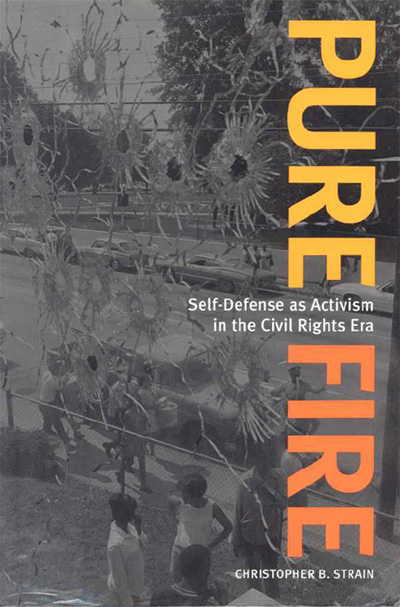


It is a really great read and part of a swing in the historiography of the Civil Rights era which argues that self defense rather than Martin Luther King Jr.'s non-violent philosophy was the norm for Black activists. It is a very convincing thesis, especially when you factor into it that many Black activists did not think that self-defense and non-violence were in opposition to each other. It is an important corrective to our historical narrative of the Civil Rights era I think and one I will incorporate when teaching this next year. It helps make sense of the Black Panther Party and Malcolm X much better, seeing them not as irrational aberrations of a type of mainstream non-violent movement, but as important elements in a much more popular expression of Black activism against White supremacy. He also brings to light some other important and interesting characters and movements, notably, Robert F. Williams from North Carolina and the Deacons for Self-Defense and Justice. I am particularly interested by Robert Williams. He had numerous debates over the merits of philosophical non-violence, and yet was vilified by some even within the civil rights era. He was the beginnings of more militant activists like Malcolm X and Huey Newton. For Williams',

'Social change is violence itself. You cannot have progress without friction and upheaval. For social change [to occur], two systems must clash. This must be a violent clash, because it's a struggle for survival for one and a struggle for liberation for the other. And always the powers in command are ruthless and unmerciful in defending their position and privileges' (65).

Here is Williams teaching his wife Mabel how to use a pistol.


Perhaps the most interesting part of the book is the chapter on the Watts Riots of 1965. At the time, these riots were the worst in US history yet were branded as irrational expressions of violence simply seeking to cause violence and anarchy. Senseless looting and rioting is what characterised Watts. Strain however argues that the Watts Riots can be seen as a type of collective self defense if historians listen to the voices of those involved. The police arrest of Marquette Frye for drunk driving was within a backdrop of constant police presence in the city. For Strain the 'conflagration', as he calls it, was a collective expression of self-defense against the oppressive presence of police in their neighbourhood. Their antagonism was only furthered by the deployment of the National Guard into Watts.

It seems to me that we need to include self-defense in our narratives of the Civil Rights movement and not just in opposition to non-violence. As Williams said, 'Self-defense is not a love of violence, it is a love of justice' (66). The philosophical and moral idealism of MLK's non-violence just didn't make sense to many people. And for others self-defense was not seen as violence at all. If anything, it shows how distorted our recollection of the movement is, as some scholars have argued, Europeans being so quick to promote MLK as the official or central narrative of the Civil Rights. Let for many African Americans their day to day was characterised by a belief in self-defense as their expression of equality.

I'll leave this post with a great piece of revolutionary art by Emory Douglas, Minister for Culture for the Black Panther Party and recent visitor to New Zealand.

Wednesday, December 2, 2009

UNC tops MSU


In more cool things, North Carolina beat Michigan State! This was a rematch of last years Championship Game (which Carolina won). Team looks so good this year! Bam!

Ed Davis is going to be great this year.

Archbishop Rowan Williams on DRC

Here is a statement from the Archbishop of Canterbury, Rowan Williams, which 'marks the centenary of the Great Congo Demonstration led by the then Archbishop of Canterbury, Dr Randall Davidson, to protest against violence and oppression in the Congo Free State.'

'Speaking at the Royal Albert Hall on 19 November 1909, Archbishop Davidson condemned the "great wrong" perpetrated against the people of Congo, claiming, "we are ourselves in part responsible for the past, and, if that wrong be allowed to continue, by whomsoever carried out, we shall be answerable to God and man for its continuance."

One hundred years later violence in the Democratic Republic of Congo (DRC) continues to claim lives, with the conflict reportedly causing directly or indirectly the deaths of more than five million civilians since 1998. The conflict, including the latest military operations, is characterised by widespread human rights violations, including horrific acts of sexual and other violence against women and girls, the deliberate killing of civilians, and the recruitment of children as soldiers. The attacks have resulted in the mass-displacement of local communities, exacerbating existing disease and poverty. The United Nations reports that over 1 million people have been forced to flee their homes since January of this year in both eastern and northern DRC. '


This is has been called Africa's "world war", mostly in the sense because of the lives lots. Tragically this massive war and its legacy are not well known or taught.

Tuesday, December 1, 2009

Iron Man 2 looks mean

South Africa to Expand Effort to Combat AIDS

This from the NYTimes. South Africa plans to combat Aids epidemic reaching young children and mothers at risk. After the previous president denied Aids was linked to HIV this is very positive for South Africa.

I'm reminded of a movie I saw at the Human Rights Film Festival a couple of years ago about a Catholic Bishop working in South Africa who openly disagreed with Catholic teaching on contraception in the Aids communities/slums he was working in. It amazes me that the Catholic teaching is so rigid on this issue, to invitation of serious suffering amongst the people. People's lives are always more important than some set dogma or ideology. The sheer naivety of the idea that simply telling people to not have sex or to abstain can have such deadly consequences.

Perhaps the most shocking thing from the article is:
Harvard researchers estimated last year that the delay by Mr. Mbeki’s government in using antiretroviral drugs to prevent women from infecting their newborns earlier this decade led to the deaths of 35,000 babies, and that 330,000 people died prematurely for lack of treatment

Direct Democracy - Good or Bad?


The Herald on Sunday editorial discussed the dangers of being ruled by 'direct democracy'. With all the furor over the government failing to repeal Section 59 of the Crimes Act, the so-called "Anti-Smacking" Bill, there has been discussion over the merits of direct democracy and referendums which are not binding on governments. Those organisations frustrated with the governments lack of movement on this issue has promoted many to push for binding referendums, but as the Herald editorial rightly points out, there are some real dangers behind this. I'm not a political scientist, but I can see how binding referendums would be in effect, be "tyranny of the majority". It would handicap the government into continuous money being spent on changing and promoting issues. It would create an industry of vote gatherers of which the one with the most money wins. The Herald puts it well:

Binding referendums would simply magnify the potential for damage to good governance. Administrations trying to develop coherent public policy could easily have their hands tied by pre-emptive plebiscites. That's what's happened in California, where three decades of tax revolt, starting with the infamous Proposition 13 in 1978, have brought the state to the brink of bankruptcy. As the Economist has noted, it has "launched an entire industry of signature-gatherers and marketing strategists [who] circumscribe what representatives can do by deciding many policies directly".

As John Parkinson writes in his chapter on Direct Democracy in Raymond Millers edited New Zealand Politics (4th edn), 'Dominant groups - generally those who are older, male, well-off, well-educated and in certain countries, of European background - are also much more likely to vote' (p.558).

Perhaps, however, the greatest problem I feel with rule by referendum is that it presents simple yes/no answers to often very complex issues. This is means that the questions that are asked can be very difficult to interpret or can be purposefully (mis)leading questions. I also do think there is case to be made for ill-informed and uneducated decisions on serious questions and issues. Which again allows for groups with the loudest voice, the most money and the best soundbite to win.