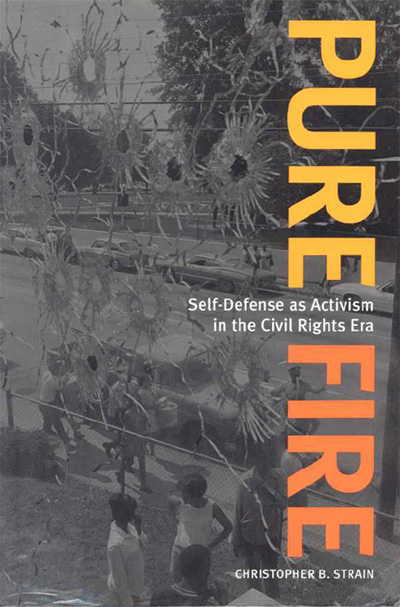
It is a really great read and part of a swing in the historiography of the Civil Rights era which argues that self defense rather than Martin Luther King Jr.'s non-violent philosophy was the norm for Black activists. It is a very convincing thesis, especially when you factor into it that many Black activists did not think that self-defense and non-violence were in opposition to each other. It is an important corrective to our historical narrative of the Civil Rights era I think and one I will incorporate when teaching this next year. It helps make sense of the Black Panther Party and Malcolm X much better, seeing them not as irrational aberrations of a type of mainstream non-violent movement, but as important elements in a much more popular expression of Black activism against White supremacy. He also brings to light some other important and interesting characters and movements, notably, Robert F. Williams from North Carolina and the Deacons for Self-Defense and Justice. I am particularly interested by Robert Williams. He had numerous debates over the merits of philosophical non-violence, and yet was vilified by some even within the civil rights era. He was the beginnings of more militant activists like Malcolm X and Huey Newton. For Williams',
'Social change is violence itself. You cannot have progress without friction and upheaval. For social change [to occur], two systems must clash. This must be a violent clash, because it's a struggle for survival for one and a struggle for liberation for the other. And always the powers in command are ruthless and unmerciful in defending their position and privileges' (65).
Here is Williams teaching his wife Mabel how to use a pistol.

Perhaps the most interesting part of the book is the chapter on the Watts Riots of 1965. At the time, these riots were the worst in US history yet were branded as irrational expressions of violence simply seeking to cause violence and anarchy. Senseless looting and rioting is what characterised Watts. Strain however argues that the Watts Riots can be seen as a type of collective self defense if historians listen to the voices of those involved. The police arrest of Marquette Frye for drunk driving was within a backdrop of constant police presence in the city. For Strain the 'conflagration', as he calls it, was a collective expression of self-defense against the oppressive presence of police in their neighbourhood. Their antagonism was only furthered by the deployment of the National Guard into Watts.
It seems to me that we need to include self-defense in our narratives of the Civil Rights movement and not just in opposition to non-violence. As Williams said, 'Self-defense is not a love of violence, it is a love of justice' (66). The philosophical and moral idealism of MLK's non-violence just didn't make sense to many people. And for others self-defense was not seen as violence at all. If anything, it shows how distorted our recollection of the movement is, as some scholars have argued, Europeans being so quick to promote MLK as the official or central narrative of the Civil Rights. Let for many African Americans their day to day was characterised by a belief in self-defense as their expression of equality.
I'll leave this post with a great piece of revolutionary art by Emory Douglas, Minister for Culture for the Black Panther Party and recent visitor to New Zealand.


 Posts
Posts


No comments:
Post a Comment