Wednesday, January 27, 2010
Howard Zinn died 27 January 2009
Democracy Now! has a good little write up of Howard Zinn, who commented on the show frequently.

Howard Zinn died 27 January 2009
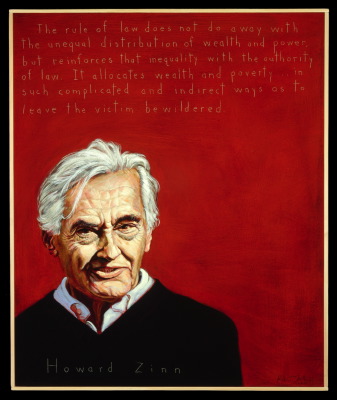
I would like to make a small post mention of US historian Howard Zinn, author (and activist) of A People's History of the United States. Which has been copied by nearly everyone, including Christianity. The book has its own wikipedia entry. Howard Zinn passed away yesterday which is a tragic loss to history and humanity. Zinn was an activist who spoke out against the unbelieveable corruption and war criminals who lead the US over the last decade, as well as being vocal against the elites who have dominated US history. His book will be recommended reading in my history class this year. You can find a number of his books, interviews and speeches/lectures online. I'll finish with some quotes of his:
If those in charge of our society — politicians, corporate executives, and owners of press and television — can dominate our ideas, they will be secure in their power. They will not need soldiers patrolling the streets. We will control ourselves
There is no flag large enough to cover the shame of killing innocent people for a purpose which is unattainable
It is possible, reading standard histories, to forget half the population of the country. The explorers were men, the landholders and merchants men, the political leaders men, the military figures men. The very invisibility of women, the overlooking of women, is a sign of their submerged status
And my favourite, (thanks to friend Rebekah Nathan for sharing):
I suggest that if you know history, then you might not be so easily
fooled by the government when it tells you you must go to war for this
or that reason -that history is a protective armor against being
misled
Tuesday, January 26, 2010
The Value of Nothing
Would like to read Raj Patal's new book, The Value of Nothing. Here is a preview:
I love that Oscar Wilde quote: 'people know the price of everything and the value of nothing'. Looks a little Naomi Kleinesque, which is all good. Perhaps i should read his first book first though...
I love that Oscar Wilde quote: 'people know the price of everything and the value of nothing'. Looks a little Naomi Kleinesque, which is all good. Perhaps i should read his first book first though...
Sunday, January 24, 2010
Religion and Facebook
Here is an interesting article from Christianity Today about 'Religious Self-Profiling' on new social media sites like MySpace and Facebook. It looks at how young people (majority users of SNS) define their religion (in the 100 words or less) in their status. It draws on this research from a University of North Carolina PhD student.
What they discover is that often people's religious views are implicit and ambigious, as opposed to outright 'evangelical', 'Christian'. They may uses other coded references such as their offline activity etc. They conclude that perhaps young people are more concerned to not limit their marketability to others and also because explicit Christian labels may have negative politic/social connotations they do not want to be associated with.
What they discover is that often people's religious views are implicit and ambigious, as opposed to outright 'evangelical', 'Christian'. They may uses other coded references such as their offline activity etc. They conclude that perhaps young people are more concerned to not limit their marketability to others and also because explicit Christian labels may have negative politic/social connotations they do not want to be associated with.
Paul Farmer on Haiti - A Must Read
Paul Farmer has an excellent article on Haiti's history and the brutal colonial involvement of the French and the US. Well worth the investment of time to read it. Paul Farmer is: physician and anthropologist, is Maud and Lillian Presley Professor at Harvard Medical School and author of 'The Uses of Haiti' and 'Pathologies of Power'. I have a copy of the second book but have not read it yet. Some extracts:
International financial institutions engaged in discriminatory and probably illegal practices towards Haiti. According to the London-based Haiti Support Group,
Haiti’s debt to international financial institutions and foreign governments has grown from $302 million in 1980 to $1.134 billion today. About 40 per cent of this debt stems from loans to the brutal Duvalier dictators, who invested precious little of it in the country. This is known as ‘odious debt’ because it was used to oppress the people, and, according to international law, this debt need not be repaid.
Yet in order to meet the renewed demands of the IDB, the cash-strapped Haitian government was required to pay ever-expanding arrears on its debts, many of them linked to loans paid out to the Duvalier dictatorship and to the military regimes that ruled Haiti with great brutality from 1986 to 1990. In July 2003, Haiti sent more than 90 per cent of all its foreign reserves to Washington to pay off these arrears. As of today, less than $4 million of the four blocked loans – which totalled $146 million – has reached Haiti in spite of many assurances from the IDB.
That the US and France undermined Aristide is not a fringe opinion. The Caribbean Community (CARICOM) and the African Union have called for a formal investigation into his removal. ‘Most people around the world believe that Aristide’s departure was at best facilitated, at worst coerced by the US and France,’ Gayle Smith, a member of the National Security Council staff under Clinton, recently said.
Why such animus towards Haiti’s leader? Taking up the question of the historic French debt, Aristide declared that France ‘extorted this money from Haiti by force and . . . should give it back to us so that we can build primary schools, primary healthcare, water systems and roads.’ He did the maths, adding in interest and adjusting for inflation, to calculate that France owes Haiti $21,685,135,571.48 and counting. This figure was scoffed at by some of the French, who saw the whole affair as a farce mounted by their disgruntled former subjects; others, it’s increasingly clear, were insulted or angered when the point was pressed in diplomatic and legal circles.
And here is an extract from Naomi Klein's the Shock Doctrine: The Rise of Disaster Capitalism, on how disasters such as in Haiti pave the way for harmful political policies - often by external powers:
Despite all the successful attempts to exploit the 2004 tsunami, memory also proved to be an effective tool of resistance in some areas where it struck, particularly in Thailand. Dozens of coastal villages were flattened by the wave, but unlike in Sri Lanka, many Thai settlements were successfully rebuilt within months. The difference did not come from the government. Thailand's politicians were just as eager as those elsewhere to use the storm as an excuse to evict fishing people and hand over land tenure to large resorts. Yet what set Thailand apart was that villagers approached all government promises with intense skepticism and refused to wait patiently in camps for an official reconstruction plan. Instead, within weeks, hundreds of villagers engaged in what they called land "reinvasions."
They marched past the armed guards on the payroll of developers, tools in hand, and began marking off the sites where their old houses had been. In some cases, reconstruction began immediately. "I am willing to bet my life on this land, because it is ours," said Ratree Kongwatmai, who lost most of her family in the tsunami.
The most daring reinvasions were performed by Thailand's indigenous fishing peoples called the Moken, or "sea gypsies." After centuries of disenfranchisement, the Moken had no illusions that a benevolent state would give them a decent piece of land in exchange for the coastal properties that had been seized. So, in one dramatic case, the residents of the Ban Tung Wah Village in the Phang Nga province "gathered themselves together and marched right back home, where they encircled their wrecked village with rope, in a symbolic gesture to mark their land ownership," explained a report by a Thai NGO. "With the entire community camping out there, it became difficult for the authorities to chase them away, especially given the intense media attention being focused on tsunami rehabilitation." In the end, the villagers negotiated a deal with the government to give up part of their oceanfront property in exchange for legal security on the rest of their ancestral land. Today, the rebuilt village is a showcase of Moken culture, complete with museum, community centre, school and market. "Now, officials from the sub-district come to Ban Tung Wah to learn about 'people-managed tsunami rehabilitation' while researchers and university students turn up there by the bus-full to study 'indigenous people's wisdom.'"
All along the Thai coast where the tsunami hit, this kind of direct-action reconstruction is the norm. The key to their success, community leaders say, is that "people negotiate for their land rights from a position of being in occupation"; some have dubbed the practice "negotiating with your hands." Thailand's survivors have also insisted on a different kind of aid-rather than settling for handouts, they have demanded the tools to carry out their own reconstruction. Dozens of Thai architecture students and professors, for example, volunteered to help community members design their new houses and draw their own rebuilding plans; master boat builders trained villagers to make their own, more sophisticated fishing vessels. The results are communities stronger than they were before the wave. The houses on stilts built by Thai villagers in Ban Tung Wah and Baan Nairai are beautiful and sturdy; they are also cheaper, larger and cooler than the sweltering prefab cubicles on offer there from foreign contractors. A manifesto drafted by a coalition of Thai tsunami survivor communities explains the philosophy: "The rebuilding work should be done by local communities themselves, as much as possible. Keep contractors out, let communities take responsibility for their own housing."
Uniting all these examples of people rebuilding for themselves is a common theme: participants say they are not just repairing buildings but healing themselves. It makes perfect sense. The universal experience of living through a great shock is the feeling of being completely powerless: in the face of awesome forces, parents lose the ability to save their children, spouses are separated, homes-places of protection-become death traps. The best way to recover from helplessness turns out to be helping-having the right to be part of a communal recovery. "Reopening our school says this is a very special community, tied together by more than location but by spirituality, by bloodlines and by a desire to come home," said the assistant principal of Dr. Martin Luther King Jr. Elementary School in the Lower Ninth Ward of New Orleans.
International financial institutions engaged in discriminatory and probably illegal practices towards Haiti. According to the London-based Haiti Support Group,
Haiti’s debt to international financial institutions and foreign governments has grown from $302 million in 1980 to $1.134 billion today. About 40 per cent of this debt stems from loans to the brutal Duvalier dictators, who invested precious little of it in the country. This is known as ‘odious debt’ because it was used to oppress the people, and, according to international law, this debt need not be repaid.
Yet in order to meet the renewed demands of the IDB, the cash-strapped Haitian government was required to pay ever-expanding arrears on its debts, many of them linked to loans paid out to the Duvalier dictatorship and to the military regimes that ruled Haiti with great brutality from 1986 to 1990. In July 2003, Haiti sent more than 90 per cent of all its foreign reserves to Washington to pay off these arrears. As of today, less than $4 million of the four blocked loans – which totalled $146 million – has reached Haiti in spite of many assurances from the IDB.
That the US and France undermined Aristide is not a fringe opinion. The Caribbean Community (CARICOM) and the African Union have called for a formal investigation into his removal. ‘Most people around the world believe that Aristide’s departure was at best facilitated, at worst coerced by the US and France,’ Gayle Smith, a member of the National Security Council staff under Clinton, recently said.
Why such animus towards Haiti’s leader? Taking up the question of the historic French debt, Aristide declared that France ‘extorted this money from Haiti by force and . . . should give it back to us so that we can build primary schools, primary healthcare, water systems and roads.’ He did the maths, adding in interest and adjusting for inflation, to calculate that France owes Haiti $21,685,135,571.48 and counting. This figure was scoffed at by some of the French, who saw the whole affair as a farce mounted by their disgruntled former subjects; others, it’s increasingly clear, were insulted or angered when the point was pressed in diplomatic and legal circles.
And here is an extract from Naomi Klein's the Shock Doctrine: The Rise of Disaster Capitalism, on how disasters such as in Haiti pave the way for harmful political policies - often by external powers:
Despite all the successful attempts to exploit the 2004 tsunami, memory also proved to be an effective tool of resistance in some areas where it struck, particularly in Thailand. Dozens of coastal villages were flattened by the wave, but unlike in Sri Lanka, many Thai settlements were successfully rebuilt within months. The difference did not come from the government. Thailand's politicians were just as eager as those elsewhere to use the storm as an excuse to evict fishing people and hand over land tenure to large resorts. Yet what set Thailand apart was that villagers approached all government promises with intense skepticism and refused to wait patiently in camps for an official reconstruction plan. Instead, within weeks, hundreds of villagers engaged in what they called land "reinvasions."
They marched past the armed guards on the payroll of developers, tools in hand, and began marking off the sites where their old houses had been. In some cases, reconstruction began immediately. "I am willing to bet my life on this land, because it is ours," said Ratree Kongwatmai, who lost most of her family in the tsunami.
The most daring reinvasions were performed by Thailand's indigenous fishing peoples called the Moken, or "sea gypsies." After centuries of disenfranchisement, the Moken had no illusions that a benevolent state would give them a decent piece of land in exchange for the coastal properties that had been seized. So, in one dramatic case, the residents of the Ban Tung Wah Village in the Phang Nga province "gathered themselves together and marched right back home, where they encircled their wrecked village with rope, in a symbolic gesture to mark their land ownership," explained a report by a Thai NGO. "With the entire community camping out there, it became difficult for the authorities to chase them away, especially given the intense media attention being focused on tsunami rehabilitation." In the end, the villagers negotiated a deal with the government to give up part of their oceanfront property in exchange for legal security on the rest of their ancestral land. Today, the rebuilt village is a showcase of Moken culture, complete with museum, community centre, school and market. "Now, officials from the sub-district come to Ban Tung Wah to learn about 'people-managed tsunami rehabilitation' while researchers and university students turn up there by the bus-full to study 'indigenous people's wisdom.'"
All along the Thai coast where the tsunami hit, this kind of direct-action reconstruction is the norm. The key to their success, community leaders say, is that "people negotiate for their land rights from a position of being in occupation"; some have dubbed the practice "negotiating with your hands." Thailand's survivors have also insisted on a different kind of aid-rather than settling for handouts, they have demanded the tools to carry out their own reconstruction. Dozens of Thai architecture students and professors, for example, volunteered to help community members design their new houses and draw their own rebuilding plans; master boat builders trained villagers to make their own, more sophisticated fishing vessels. The results are communities stronger than they were before the wave. The houses on stilts built by Thai villagers in Ban Tung Wah and Baan Nairai are beautiful and sturdy; they are also cheaper, larger and cooler than the sweltering prefab cubicles on offer there from foreign contractors. A manifesto drafted by a coalition of Thai tsunami survivor communities explains the philosophy: "The rebuilding work should be done by local communities themselves, as much as possible. Keep contractors out, let communities take responsibility for their own housing."
Uniting all these examples of people rebuilding for themselves is a common theme: participants say they are not just repairing buildings but healing themselves. It makes perfect sense. The universal experience of living through a great shock is the feeling of being completely powerless: in the face of awesome forces, parents lose the ability to save their children, spouses are separated, homes-places of protection-become death traps. The best way to recover from helplessness turns out to be helping-having the right to be part of a communal recovery. "Reopening our school says this is a very special community, tied together by more than location but by spirituality, by bloodlines and by a desire to come home," said the assistant principal of Dr. Martin Luther King Jr. Elementary School in the Lower Ninth Ward of New Orleans.
Thursday, January 21, 2010
Some News Links Round -Up
Thought I would quickly keep my postings regular by adding some stuff i've been reading today, briefly.
This is unbelievable, but a US arms manufacturer has been making weapons with special light/scopes on them for better vision when shooting people in Afghanistan. They also happened to put a bible verse on it. New Zealand troops have been using these weapons overseas. Here is the Guardian story. This is so shocking and incredibly offensive to Christian's who believe Jesus was a bringer of peace, not war and weapons to kill people with. As the Guardian reports, there were two verses printed on the weapons:
Markings included "JN8:12", a reference to John 8:12: "Then spake Jesus again unto them, saying, 'I am the light of the world: he that followeth me shall not walk in darkness, but shall have the light of life,'" according to the King James version of the Bible.
The Trijicon Reflex sight is stamped with 2COR4:6, a reference to part of the second letter of Paul to the Corinthians: "For God, who commanded the light to shine out of darkness, hath shined in our hearts, to give the light of the knowledge of the glory of God in the face of Jesus Christ," the King James version reads.
I'm pretty sure that is not what Jesus had in mind. The story was also picked up by Fox, the New Zealand Herald
Kofi Annan talks about 'Turning Haiti around' here.
A horrific article on lower caste people in India whose job it is to manually clean up people's urine and crap. My cousin works for WaterAid, an ngo which released this report. As she said on Facebook, if you think you have the worst job, read this.
And finally, a nostalgic review of the Kraft buying Cadbury deal, which I have to say I agree with. It is a sad thing for everything to be made by one giant company. As Naomi Klein wrote about in NoLogo. What is more concerning is whether this deal will end Cadbury's commitment to FairTrading it's Dairy Milk line. I think it does. But here's hoping.
And after all that, it looks like all i do is link to the Guardian. Maybe everyone should just read that.
This is unbelievable, but a US arms manufacturer has been making weapons with special light/scopes on them for better vision when shooting people in Afghanistan. They also happened to put a bible verse on it. New Zealand troops have been using these weapons overseas. Here is the Guardian story. This is so shocking and incredibly offensive to Christian's who believe Jesus was a bringer of peace, not war and weapons to kill people with. As the Guardian reports, there were two verses printed on the weapons:
Markings included "JN8:12", a reference to John 8:12: "Then spake Jesus again unto them, saying, 'I am the light of the world: he that followeth me shall not walk in darkness, but shall have the light of life,'" according to the King James version of the Bible.
The Trijicon Reflex sight is stamped with 2COR4:6, a reference to part of the second letter of Paul to the Corinthians: "For God, who commanded the light to shine out of darkness, hath shined in our hearts, to give the light of the knowledge of the glory of God in the face of Jesus Christ," the King James version reads.
I'm pretty sure that is not what Jesus had in mind. The story was also picked up by Fox, the New Zealand Herald
Kofi Annan talks about 'Turning Haiti around' here.
A horrific article on lower caste people in India whose job it is to manually clean up people's urine and crap. My cousin works for WaterAid, an ngo which released this report. As she said on Facebook, if you think you have the worst job, read this.
And finally, a nostalgic review of the Kraft buying Cadbury deal, which I have to say I agree with. It is a sad thing for everything to be made by one giant company. As Naomi Klein wrote about in NoLogo. What is more concerning is whether this deal will end Cadbury's commitment to FairTrading it's Dairy Milk line. I think it does. But here's hoping.
And after all that, it looks like all i do is link to the Guardian. Maybe everyone should just read that.
Tuesday, January 19, 2010
Haiti analysis and critique....
Found these two articles interesting.
One from NYtimes coloumist David Brooks on Haiti. And a response/translation of Brooks underlying assumptions here.
One from NYtimes coloumist David Brooks on Haiti. And a response/translation of Brooks underlying assumptions here.
Monday, January 18, 2010
Martin Luther King Jr. Day

Today is MLK Jr. Day in the US, the only official public holiday after an African American. I haven't read much from the news about it, but have come across some good things to read. Just because i'm an NBA fan, here is Dwight Howard's blog post on today. African American philosopher and theologian, Cornel West, gave a speech at Ebenezer Baptist Church in Alabama where King preached at from 1960-1968. I haven't been able to find a full text of the speech, but i would like to read it. From the news reports, West warns Americans to not 'sanitize' King's legacy and to make his appeals to help the poor real and urgent today. I like West and I think he is right to make such remarks.
With that in mind here are some amazing speeches he made. The first in New York from April 1967 called 'Beyond Vietnam', one year before he would be assassinated. You can see from the tone of the speech that King was becoming more radical and hostile towards not just racism, but the Vietnam War and US militarisation in general, as well as economic justice issues. Themes which the Black Power movement had also been promoting for years.
Today is Martin Luther King Day, a federal holiday in the US. The following is an extract of a speech delivered by King on 4 April 1967 in New York City.
These are revolutionary times. All over the globe men are revolting against old systems of exploitation and oppression and out of the wombs of a frail world new systems of justice and equality are being born. The shirtless and barefoot people of the land are rising up as never before. "The people who sat in darkness have seen a great light." We in the west must support these revolutions. It is a sad fact that, because of comfort, complacency, a morbid fear of communism, and our proneness to adjust to injustice, the western nations that initiated so much of the revolutionary spirit of the modern world have now become the arch anti-revolutionaries. This has driven many to feel that only Marxism has the revolutionary spirit. Therefore, communism is a judgement against our failure to make democracy real and follow through on the revolutions we initiated. Our only hope today lies in our ability to recapture the revolutionary spirit and go out into a sometimes hostile world declaring eternal hostility to poverty, racism, and militarism. With this powerful commitment we shall boldly challenge the status quo and unjust mores and thereby speed the day when "every valley shall be exalted, and every mountain and hill shall be made low, and the crooked shall be made straight and the rough places plain."
A genuine revolution of values means in the final analysis that our loyalties must become ecumenical rather than sectional. Every nation must now develop an overriding loyalty to mankind as a whole in order to preserve the best in their individual societies.
This call for a world-wide fellowship that lifts neighbourly concern beyond one's tribe, race, class and nation is in reality a call for an all-embracing and unconditional love for all men. This oft misunderstood and misinterpreted concept – so readily dismissed by the Nietzsches of the world as a weak and cowardly force – has now become an absolute necessity for the survival of man. When I speak of love I am not speaking of some sentimental and weak response. I am speaking of that force which all of the great religions have seen as the supreme unifying principle of life. Love is somehow the key that unlocks the door which leads to ultimate reality. This Hindu-Moslem-Christian-Jewish-Buddhist belief about ultimate reality is beautifully summed up in the first epistle of St John:
Let us love one another; for love is God and everyone that loveth is born of God and knoweth God. He that loveth not knoweth not God; for God is love. If we love one another God dwelleth in us, and his love is perfected in us.
Let us hope that this spirit will become the order of the day. We can no longer afford to worship the god of hate or bow before the altar of retaliation. The oceans of history are made turbulent by the ever-rising tides of hate. History is cluttered with the wreckage of nations and individuals that pursued this self-defeating path of hate. As Arnold Toynbee says : "Love is the ultimate force that makes for the saving choice of life and good against the damning choice of death and evil. Therefore the first hope in our inventory must be the hope that love is going to have the last word."
We are now faced with the fact that tomorrow is today. We are confronted with the fierce urgency of now. In this unfolding conundrum of life and history there is such a thing as being too late. Procrastination is still the thief of time. Life often leaves us standing bare, naked and dejected with a lost opportunity. The "tide in the affairs of men" does not remain at the flood; it ebbs. We may cry out desperately for time to pause in her passage, but time is deaf to every plea and rushes on. Over the bleached bones and jumbled residue of numerous civilizations are written the pathetic words: "Too late." There is an invisible book of life that faithfully records our vigilance or our neglect. "The moving finger writes, and having writ moves on..." We still have a choice today: nonviolent coexistence or violent co-annihilation.
We must move past indecision to action. We must find new ways to speak for peace in Vietnam and justice throughout the developing world – a world that borders on our doors. If we do not act we shall surely be dragged down the long, dark and shameful corridors of time reserved for those who possess power without compassion, might without morality, and strength without sight.
Now let us begin. Now let us rededicate ourselves to the long and bitter – but beautiful – struggle for a new world. This is the calling of the sons of God, and our brothers wait eagerly for our response. Shall we say the odds are too great? Shall we tell them the struggle is too hard? Will our message be that the forces of American life militate against their arrival as full men, and we send our deepest regrets? Or will there be another message, of longing, of hope, of solidarity with their yearnings, of commitment to their cause, whatever the cost? The choice is ours, and although we might prefer it otherwise we must choose in this crucial moment of human history.
As that noble bard of yesterday, James Russell Lowell, eloquently stated:
Once to every man and nation
Comes the moment to decide,
In the strife of truth and falsehood,
For the good or evil side;
Some great cause, God's new Messiah,
Off'ring each the bloom or blight,
And the choice goes by forever
Twixt that darkness and that light.
Though the cause of evil prosper,
Yet 'tis truth alone is strong;
Though her portion be the scaffold,
And upon the throne be wrong:
Yet that scaffold sways the future,
And behind the dim unknown,
Standeth God within the shadow
Keeping watch above his own.
And if we will only make the right choice, we will be able to transform this pending cosmic elegy into a creative psalm of peace. If we will make the right choice, we will be able to transform the jangling discords of our world into a beautiful symphony of brotherhood. (The full text can be read and heard here.)
Sojouners also had a nice collection of speeches and thoughts on their email newsletter by Ruth Hawley-Lowry.
Reading King's speeches still give me goosebumps. I feel so lucky that i can teach about him to teenagers this year. I further think it is important to remember that the Civil Rights Movement was not a result of MLK Jr. History is seldom the result of the 'Big Men' who we often remember it by. Just as there is a Martin Luther King Jr. Day we should also remember other Civil Rights activists, not just in the US but all around the world. But in particular for the US, these names should precede or join King: Malcolm X, Robert F. Williams, Ella Baker, Ralph Abernathy, Stokely Carmichael, Medger Evers, James L. Farmer, Fannie Lou Hamer, Thurgood Marshall, A. Phillip Randolph, Huey P. Newton, Bobby Seale and so many more.
If you want to read more about the Civil Rights movement read my post/book review of the Civil Rights Movement and Self Defense.
I'll end this post with my favourite MLK Jr. quote. (you can read a whole bunch of them here.)
When our days become dreary with low-hovering clouds of despair, and when our nights become darker than a thousand midnights, let us remember that there is a creative force in this universe, working to pull down the gigantic mountains of evil, a power that is able to make a way out of no way and transform dark yesterdays into bright tomorrows. Let us realize the arc of the moral universe is long but it bends toward justice
Rick Warren Prayer Breakfast
Rick Warren was just in Rwanda last year and lead the Prayer breakfast, according to AllAfrica.com. Prayer breakfast are fascinating things for political bodies. The US president has one, and Auckland Mayor Les Mills used to do one. I'm sure they're done all over the place.
The Purpose Driven Nation? Rwanda and Rick Warren
While doing my summer scholarship research at Auckland University I came across this 2005 Time article: Warren of Rwanda. And then this follow-up article in 2008.
Time is reporting on North American evangelical, Rick Warren, pastor of the massive 23,000 member Saddleback Church and author of the best selling non-fiction book in US history, The Purpose Driven Life. In the articles Warren's aid programme, PEACE, is discussed as now being committed to 'co-operation' with Rwandan president Paul Kagame in a 5=7 year 'self-sufficiency project'. Kagame, who is not a Christian, volunteered Rwanda to become the very first 'purpose driven nation'. To give you an idea of the scope of this arrangement:
In July Warren and 48 other American Evangelicals, who have backgrounds in areas like health, education, micro-enterprises and justice, held intensive planning meetings with Rwandan Cabinet ministers, governors, clergy and entrepreneurs. One dinner was attended by a third of the Rwandan Parliament.
Warren plans on sending over 'church kits', he calls "school in a box", "clinic in a box, and "business in a box". By the end of 2008, Time reports, 1,750 PEACE volunteers will have visited Rwanda. For Kagame, the attraction seems obvious:
Not only have PEACE volunteers gone to work on health and development, Kagame says, but the more high-powered among them "use their contacts to draw on resources and attract investment. I can't have anything better than this." He admits that he is not a practicing Christian: "I cannot say I am devout, but I have a good sense of what faith is about and the usefulness of it." And in this case, he says, "what Saddleback is doing serves the church and serves us too."
It seems Kagame is more aware of developing such church connections for broader economic development alongside other social development goals. I particularly find Kagame's turn of phrase: 'the usefulness or it [religion]' instructive. Religion has a very real social power. Politically, in can derive allegiance from its members, certain types of religion can help business develop (Max Weber's famous Protestant Work Ethic thesis). Churches can create active, motivated communities and generate money and support for a number of social programmes and goals. But even the exportation of volunteers (or missionaries as some might call them) creates markets and development for businesses. It's an industry in itself and Kagame acknowledges this.
What has happen so far according to Time? :
PEACE is working with the University of Maryland to upgrade the facility and next year will give $500,000 as part of its province-wide $13 million commitment. But so far, aside from a paint job and some tidying up, there is little improvement.
As Laura Hoemeke, director of Twubakane, a USAID-funded Rwandan decentralization and health program, says, it is hard for 'short-termers' to affect long term change. Warren's response is interesting:
When Warren hears that other NGOs in Rwanda repeatedly told TIME that PEACE could offer no working examples of tangible aid-and-development projects, he laughs for 10 full seconds. "You were talking to the wrong guys," he says. Most aid-and-development experts, he claims, depend on Western-style measurements and reports. Rwandan churches, he says, have neither the time nor the obligation to produce them. Moreover, he asserts that executing a program involving spiritual goals through churches initially produces "results that tend not to be programmatic — they tend to be life change." (For instance, PEACE has recorded 10,000 baptisms in Rwanda.) Even when classic development programs are under way, he continues, "we don't sacrifice sustainability for speed. If you go back to my very first message in 2003, I said, This is going to take 50 years." He adds, "My confidence is not that I've got it all figured out. My confidence is, Jesus said, 'Do these five things,' and we've got the people out there." He is comfortable "building the plane as we fly it."
I agree with some of the points Warren makes. Western styles of measuring development are not always useful or appropriate. But that should not be used as a means of evading responsibility. He's also right in claiming he planned that programmes he's helping fund will take 50 years to develop (and that's probably being a little generous). And he is providing ways of help for hundreds of Rwandans. But i find it quite problematic when a church pledges such a broad plan as Warren's PEACE plan and has only just now (2008/2009) started to realise he needs to work with other NGO's. Further and more crucially, I am very skeptical of the short-term mission trip into a completely different culture, hoping to make 'lasting change'. Such mission trips smack of colonialism no matter how altruistic they are. Even the altruism feels like paternalism at best and blatant racism at worst. What makes the situation even more difficult is Kagame's involvement in the Second Congo War and the exploitation and deaths of Congolese for access to its minerals in the early 2000s.. I want to see if Warren has spoken out about this.
For example, (from wikipedia):
A 2002 United Nations report elaborated on the allegations of illegal profiteering by Rwandan and Ugandan forces in Congo:
“ The claims of Rwanda concerning its security have justified the continuing presence of its armed forces, whose real long-term purpose is, to use the term employed by the Congo Desk of the Rwandan Patriotic Army, to "secure property". Rwanda's leaders have succeeded in persuading the international community that their military presence in the eastern Democratic Republic of the Congo protects the country against hostile groups in the Democratic Republic of the Congo, who, they claim, are actively mounting an invasion against them.
The Panel has extensive evidence to the contrary. For example, the Panel is in possession of a letter, dated 26 May 2000, from Jean-Pierre Ondekane, First Vice-President and Chief of the Military High Command for [the Rwandan-backed rebel group] RCD-Goma, urging all army units to maintain good relations "with our Interahamwe and Mayi-Mayi brothers", and further, "if necessary to let them exploit the sub-soil for their survival"...
A 30-year-old Interahamwe combatant living in the area of Bukavu described the situation in a taped interview with a United Nations officer in early 2002:
We haven't fought much with the RPA in the last two years. We think they are tired of this war, like we are. In any case, they aren't here in the Congo to chase us, like they pretend. I have seen the gold and coltan mining they do here, we see how they rob the population. These are the reasons for their being here. The RPA come and shoot in the air and raid the villagers' houses but they don't attack us any more.
Time is reporting on North American evangelical, Rick Warren, pastor of the massive 23,000 member Saddleback Church and author of the best selling non-fiction book in US history, The Purpose Driven Life. In the articles Warren's aid programme, PEACE, is discussed as now being committed to 'co-operation' with Rwandan president Paul Kagame in a 5=7 year 'self-sufficiency project'. Kagame, who is not a Christian, volunteered Rwanda to become the very first 'purpose driven nation'. To give you an idea of the scope of this arrangement:
In July Warren and 48 other American Evangelicals, who have backgrounds in areas like health, education, micro-enterprises and justice, held intensive planning meetings with Rwandan Cabinet ministers, governors, clergy and entrepreneurs. One dinner was attended by a third of the Rwandan Parliament.
Warren plans on sending over 'church kits', he calls "school in a box", "clinic in a box, and "business in a box". By the end of 2008, Time reports, 1,750 PEACE volunteers will have visited Rwanda. For Kagame, the attraction seems obvious:
Not only have PEACE volunteers gone to work on health and development, Kagame says, but the more high-powered among them "use their contacts to draw on resources and attract investment. I can't have anything better than this." He admits that he is not a practicing Christian: "I cannot say I am devout, but I have a good sense of what faith is about and the usefulness of it." And in this case, he says, "what Saddleback is doing serves the church and serves us too."
It seems Kagame is more aware of developing such church connections for broader economic development alongside other social development goals. I particularly find Kagame's turn of phrase: 'the usefulness or it [religion]' instructive. Religion has a very real social power. Politically, in can derive allegiance from its members, certain types of religion can help business develop (Max Weber's famous Protestant Work Ethic thesis). Churches can create active, motivated communities and generate money and support for a number of social programmes and goals. But even the exportation of volunteers (or missionaries as some might call them) creates markets and development for businesses. It's an industry in itself and Kagame acknowledges this.
What has happen so far according to Time? :
PEACE is working with the University of Maryland to upgrade the facility and next year will give $500,000 as part of its province-wide $13 million commitment. But so far, aside from a paint job and some tidying up, there is little improvement.
As Laura Hoemeke, director of Twubakane, a USAID-funded Rwandan decentralization and health program, says, it is hard for 'short-termers' to affect long term change. Warren's response is interesting:
When Warren hears that other NGOs in Rwanda repeatedly told TIME that PEACE could offer no working examples of tangible aid-and-development projects, he laughs for 10 full seconds. "You were talking to the wrong guys," he says. Most aid-and-development experts, he claims, depend on Western-style measurements and reports. Rwandan churches, he says, have neither the time nor the obligation to produce them. Moreover, he asserts that executing a program involving spiritual goals through churches initially produces "results that tend not to be programmatic — they tend to be life change." (For instance, PEACE has recorded 10,000 baptisms in Rwanda.) Even when classic development programs are under way, he continues, "we don't sacrifice sustainability for speed. If you go back to my very first message in 2003, I said, This is going to take 50 years." He adds, "My confidence is not that I've got it all figured out. My confidence is, Jesus said, 'Do these five things,' and we've got the people out there." He is comfortable "building the plane as we fly it."
I agree with some of the points Warren makes. Western styles of measuring development are not always useful or appropriate. But that should not be used as a means of evading responsibility. He's also right in claiming he planned that programmes he's helping fund will take 50 years to develop (and that's probably being a little generous). And he is providing ways of help for hundreds of Rwandans. But i find it quite problematic when a church pledges such a broad plan as Warren's PEACE plan and has only just now (2008/2009) started to realise he needs to work with other NGO's. Further and more crucially, I am very skeptical of the short-term mission trip into a completely different culture, hoping to make 'lasting change'. Such mission trips smack of colonialism no matter how altruistic they are. Even the altruism feels like paternalism at best and blatant racism at worst. What makes the situation even more difficult is Kagame's involvement in the Second Congo War and the exploitation and deaths of Congolese for access to its minerals in the early 2000s.. I want to see if Warren has spoken out about this.
For example, (from wikipedia):
A 2002 United Nations report elaborated on the allegations of illegal profiteering by Rwandan and Ugandan forces in Congo:
“ The claims of Rwanda concerning its security have justified the continuing presence of its armed forces, whose real long-term purpose is, to use the term employed by the Congo Desk of the Rwandan Patriotic Army, to "secure property". Rwanda's leaders have succeeded in persuading the international community that their military presence in the eastern Democratic Republic of the Congo protects the country against hostile groups in the Democratic Republic of the Congo, who, they claim, are actively mounting an invasion against them.
The Panel has extensive evidence to the contrary. For example, the Panel is in possession of a letter, dated 26 May 2000, from Jean-Pierre Ondekane, First Vice-President and Chief of the Military High Command for [the Rwandan-backed rebel group] RCD-Goma, urging all army units to maintain good relations "with our Interahamwe and Mayi-Mayi brothers", and further, "if necessary to let them exploit the sub-soil for their survival"...
A 30-year-old Interahamwe combatant living in the area of Bukavu described the situation in a taped interview with a United Nations officer in early 2002:
We haven't fought much with the RPA in the last two years. We think they are tired of this war, like we are. In any case, they aren't here in the Congo to chase us, like they pretend. I have seen the gold and coltan mining they do here, we see how they rob the population. These are the reasons for their being here. The RPA come and shoot in the air and raid the villagers' houses but they don't attack us any more.
Wednesday, January 13, 2010
Haitian NBA player Samual Dalembert's foundation

Democracy Now! Coverage of Haiti earthquake
Some good news coverage of the earthquake in Haiti at Democracy Now.
Give money to help here:
World Vision
Oxfam New Zealand
Give money to help here:
World Vision
Oxfam New Zealand
Tuesday, January 12, 2010
Good song: Middle East, 'Blood'.
Thanks to a mention from my friend Amy, i've been listening to this song by Australian band, The Middle East, called 'Blood'. It's a very nice song with some very good lyrics. Enjoy.
older brother, restless soul, lie down
lie for a while with your ear against the earth
and you'll hear your sister sleep talking
say "your hair is long but not long enough to reach
home to me
but your beard
someday might be"
and she'll wake up in a cold sweat on the floor
next to a family portrait drawn when you were four
and beside a jar of two cent coins that are no good no more
she'll lay it aside
older father, weary soul, you'll drive
back to the home you made on the mountainside
with that ugly, terrible thing
those papers for divorce
and a lonely ring
a lonely ring
sit on your porch
and pluck your strings
and you'll find somebody you can blame
and you'll follow the creek that runs out into the sea
and you'll find the peace of the Lord.
grandfather, gentle soul, you'll fly
over your life once more before you die
since our grandma passed away
you've waited for forever and a day
just to die
and someday soon
you will die
it was the only woman you ever loved
that got burnt by the sun too often when she was young
and the cancer spread and it ran into her body and her blood
and there's nothing you can do about it now
older brother, restless soul, lie down
lie for a while with your ear against the earth
and you'll hear your sister sleep talking
say "your hair is long but not long enough to reach
home to me
but your beard
someday might be"
and she'll wake up in a cold sweat on the floor
next to a family portrait drawn when you were four
and beside a jar of two cent coins that are no good no more
she'll lay it aside
older father, weary soul, you'll drive
back to the home you made on the mountainside
with that ugly, terrible thing
those papers for divorce
and a lonely ring
a lonely ring
sit on your porch
and pluck your strings
and you'll find somebody you can blame
and you'll follow the creek that runs out into the sea
and you'll find the peace of the Lord.
grandfather, gentle soul, you'll fly
over your life once more before you die
since our grandma passed away
you've waited for forever and a day
just to die
and someday soon
you will die
it was the only woman you ever loved
that got burnt by the sun too often when she was young
and the cancer spread and it ran into her body and her blood
and there's nothing you can do about it now
Sunday, January 10, 2010
The Americanization of Mental Illness
Haven't read all of this article from the NY Times magazine on mental illness, but it looks interesting. From what i've read it seems to reassert the Foucauldian notion of mental illness as culturally and socially constructed in some ways.
New Oliver Stone TV show: Oliver Stone's Secret History of America.
The Guardian reports on American filmmaker Oliver Stone's new project. Looks quite interesting, and not as controversial as the article or Stone are trying to make it sound. History graduates, I'd argue, are taught how to understand Hitler as a product of context, as much as his own personality. He was not some sort of disembodied demagogue from the start. There was a specific historical situation in Germany which gave room for Hitler and the National Socialists. Still, will be interesting to see what becomes of it. Could be useful in the classroom!What I think is more controversial and perverse is the use of Hitler colloquially in everyday discourse, particularly on the Internet. Comparisons of contemporary people or issues to Hitler or Nazism on the internet is known as Godwin's law, in which Mike Godwin, who formulated the theory, suggests that as an online forum or discussions goes longer the probability of the conversation involving a comparison to Hitler grows. Such comparisons are historically fallacious and unimaginably offensive, especially to people who suffered and died under the Third Reich. The same goes for Nazi costume parties and even Nazi toys/models for model war games etc. I feel the same about Chairman Mao images on clothing.
Thursday, January 7, 2010
The "Single Story" of "Africa"
A very good sociology blog, Sociological Images, has posted this TED lecture by novelist, Chimamanda Adichie, about the western construction of Africa. As the blog introduces:
'In this 20 minute video, novelist Chimamanda Adichie describes, with insight and grace, the problem of the “single story.” She says, “Show a people as one thing, and only one thing, over and over again, and that is what they become.” Focusing on her experience as an “African” in the U.S. (she is from Nigeria), she also describes her own experiences with realizing that she has heard only a single story, whether of rural Nigerians or Mexicans.'
The blog Stuff White People Like also has a post on this (rather humorous).
Also see this video on YouTube, How Not to Speak of Africa.
All people are capable of reducing people to a "single story". But always, those with Power (white, male, mostly) are able to control, tell, and shape these narratives and stereotypes. Which as Adichie says, are not necessarily untrue, but are rather 'incomplete'. They tell half a story, or reduces, simplifies and emphasizes what certain attributes and cultures a people have. And often for people from the African continent, this means reducing the countries and people of Africa into one single people, narrative and experience.
'In this 20 minute video, novelist Chimamanda Adichie describes, with insight and grace, the problem of the “single story.” She says, “Show a people as one thing, and only one thing, over and over again, and that is what they become.” Focusing on her experience as an “African” in the U.S. (she is from Nigeria), she also describes her own experiences with realizing that she has heard only a single story, whether of rural Nigerians or Mexicans.'
The blog Stuff White People Like also has a post on this (rather humorous).
Also see this video on YouTube, How Not to Speak of Africa.
All people are capable of reducing people to a "single story". But always, those with Power (white, male, mostly) are able to control, tell, and shape these narratives and stereotypes. Which as Adichie says, are not necessarily untrue, but are rather 'incomplete'. They tell half a story, or reduces, simplifies and emphasizes what certain attributes and cultures a people have. And often for people from the African continent, this means reducing the countries and people of Africa into one single people, narrative and experience.
Wednesday, January 6, 2010
Elitist Education and Social Reproduction: The Return of Bourdieu
Two recent news items about elitism and education have come up, in France and New Zealand, raising the question of the role of education in reproducing social hierarchies and class stratification. In France, Sarkozy has called for the Elite Colleges (Grandes Ecoles) to accept quotas of students from poorer income backgrounds. The elite colleges have responded calling the quotas and attempt to lower the standards of the institutions (some of which have been around since 1800s). There was however no intention to lower entrance standards. What the quotas would have guaranteed was that the preliminary entrance exams, which are financially taxing on poorer families, would not stop poorer students without the money and family connections from having their children attend. Such preliminary entrance tests are not set up to test the students ability to enter. Those students already have A Levels (or equivalent) and would gain entrance if it was solely based on this. However, the goal of these institutions is largely to reproduce a type of anachronistic 'republican elite'.
Ironically enough this is all occurring in France where the origins of social reproduction theory was developed and demonstrated by sociologist Pierre Bourdieu. Bourdieu argued that education systems where not neutral environments and they largely served to reproduced whatever the dominated social structure and class stratification which exists. To prove his case Bourdieu looked at French education system and found that only certain types of students were successful. Students that have the most success are those able to operate and trade their cultural and social capital within the school system which only accepts certain social and cultural capital as acceptable. If your background, culture, beliefs, philosophy about learning, doesn't align with the dominate class, then it is not able to be accommodated in the education system Bourdieu argued that those from a working class background were at a disadvantage from the start because the middle-class/upper-class sets the cultural capital needed to be successful in schooling (a very middle/upper-class institution). All the necessary discourse, culture, behaviour and attitudes the school reflects are embodied and well developed for certain classes/people and not others. Therefore society reproduces itself through education.
The French elite colleges is simply another example of this principle in operation. A similar situation has arisen in New Zealand. Where the government is paying scholarships for poorer students to attend private secondary schools. The idea that students would receive a better education at a private secondary school than a state school is very problematic. Those tax-payer funded resources should instead be spent on a public schools in desperate need of more funding. What needs to change is the barriers which hold students from lower socio-economic backgrounds and who hold different types of cultural capital a chance to participant and succeed. Hopefully at the same time challenging rigid social and class hierarchies.

Ironically enough this is all occurring in France where the origins of social reproduction theory was developed and demonstrated by sociologist Pierre Bourdieu. Bourdieu argued that education systems where not neutral environments and they largely served to reproduced whatever the dominated social structure and class stratification which exists. To prove his case Bourdieu looked at French education system and found that only certain types of students were successful. Students that have the most success are those able to operate and trade their cultural and social capital within the school system which only accepts certain social and cultural capital as acceptable. If your background, culture, beliefs, philosophy about learning, doesn't align with the dominate class, then it is not able to be accommodated in the education system Bourdieu argued that those from a working class background were at a disadvantage from the start because the middle-class/upper-class sets the cultural capital needed to be successful in schooling (a very middle/upper-class institution). All the necessary discourse, culture, behaviour and attitudes the school reflects are embodied and well developed for certain classes/people and not others. Therefore society reproduces itself through education.
The French elite colleges is simply another example of this principle in operation. A similar situation has arisen in New Zealand. Where the government is paying scholarships for poorer students to attend private secondary schools. The idea that students would receive a better education at a private secondary school than a state school is very problematic. Those tax-payer funded resources should instead be spent on a public schools in desperate need of more funding. What needs to change is the barriers which hold students from lower socio-economic backgrounds and who hold different types of cultural capital a chance to participant and succeed. Hopefully at the same time challenging rigid social and class hierarchies.
Subscribe to:
Posts (Atom)

 Posts
Posts

